
When Lidl Dropped Print Flyers: Lessons in Consumer Behaviour
Landmark Netherlands field experiment demonstrates the impact of printed leaflets on shopper behaviour and sales.
Few questions in marketing are asked as often—or answered as poorly—as whether print still moves markets. A rare large-scale field experiment in the Netherlands has now provided clear evidence. In 2025, researchers from Tilburg University, the University of North Carolina at Chapel Hill, and the University of Amsterdam published a paper analysing what happened when Lidl, one of the world's largest supermarket chains and best marketers, stopped delivering its printed flyers in Utrecht province.

Everywhere else in the country, the practice continued. That created a natural experiment. By comparing Utrecht with a control group of similar provinces where flyers were still delivered, the researchers could pinpoint the effect of removing print with a clarity rarely achieved in advertising research.
The measurable cost of cutting print
The headline figure was stark. When the printed flyer disappeared, shopper spending at Lidl fell by around five per cent. The decline reflected both fewer shopping trips and smaller baskets. In other words, the absence of print altered not just whether people came, but how much they bought when they did.
The losses were not uniform. Younger shoppers—often presumed to be “digital only”—registered some of the steepest declines. So did spending by shoppers not already using the retailer’s loyalty app. The very groups thought most easily reached online turned out to be among the most influenced by a physical leaflet.
Digital could not fill the gap
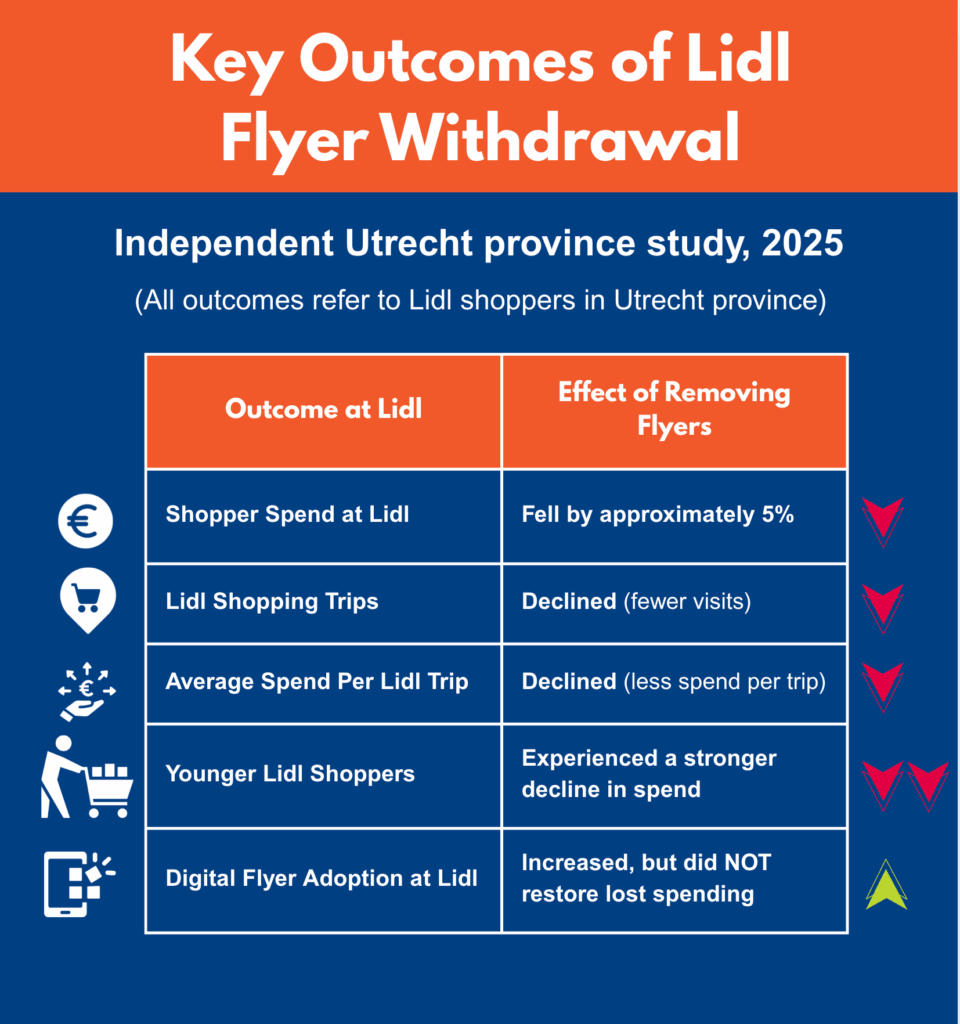
The retailer pushed shoppers toward digital flyers. Uptake grew, but even among those who adopted the online version, spending did not fully recover. The same offers, in a digital medium, did not carry the same weight.
This suggests that print’s influence lies in more than its content. A leaflet on a kitchen table or fridge is a repeated, shared prompt. It is seen in passing, brought into household conversations, and considered during list-making. A digital flyer, by contrast, requires a deliberate action to find it and remains invisible until summoned.
Competitive effects and default behaviour
The study also found that Lidl’s rivals did not enjoy a neat transfer of spend. Instead, shoppers tended to reallocate more of their grocery budget back to whichever alternative supermarket was already their main option. This points to a subtler role for print: it disrupts consumer inertia, nudging shoppers to consider a different store. Remove it, and established habits quickly reassert themselves.
Scientific rigour and unusual scale
The scale of the evidence is rare. The authors analysed transaction-level scanner data covering nearly seven million customers, providing an unusually robust view of real behaviour rather than self-reported intentions. To understand mechanisms, they supplemented this with a household survey in Utrecht. The survey confirmed that many consumers were unaware of the digital alternative, and that even those who did switch did not behave as before.
The study is a milestone: a clean provincial intervention, state-of-the-art difference-in-differences modelling, and both large-scale behavioural data and survey evidence. Together, these elements make a strong causal case: withdrawing print directly reduced revenue.
Lessons for Tourism Businesses
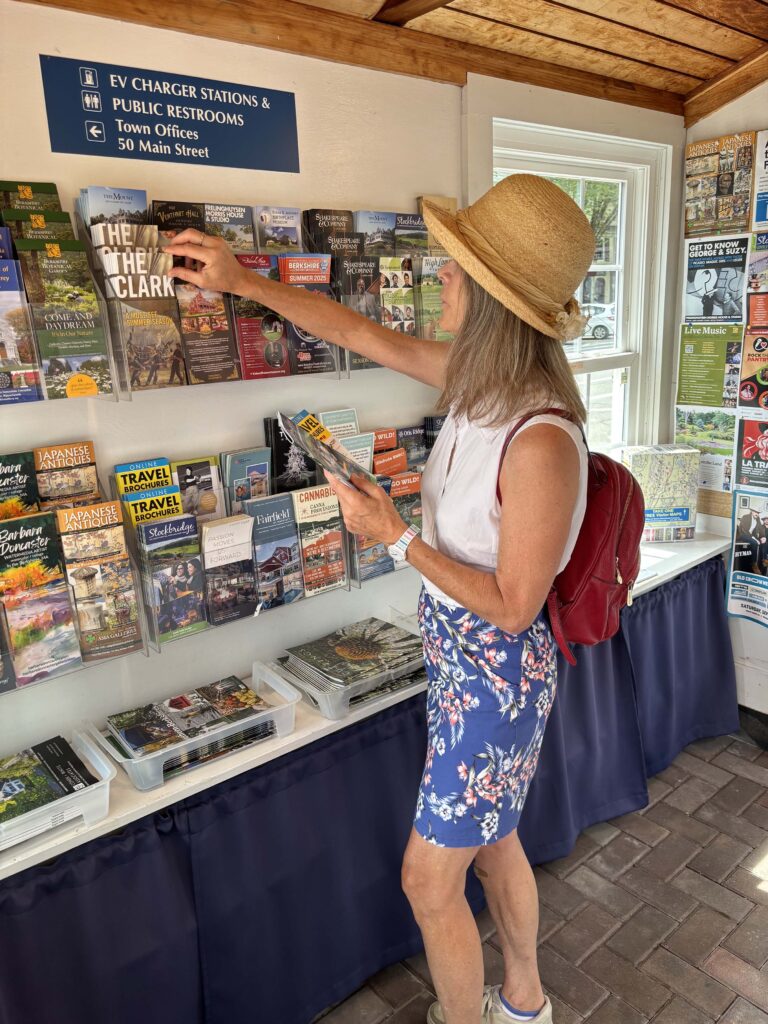
Although the survey and setting was grocery retail, the lesson for tourism is even more compelling. In Lidl’s case, flyers were pushed uninvited through household doors—yet even then they drove measurable changes in spending. Visitor brochures, by contrast, are chosen out of curiosity and intent. Picking one up from a rack is not a passive exposure but an active decision, a spark of interest. That moment of choice makes the likely outcome even more powerful: the information is not merely glanced at, it is welcomed into the decision-making process. It is a 100% opt-in message.
Once chosen, a brochure travels with the visitor. It slips into a bag, rests on a nightstand, or is spread across the breakfast table, ready to shape the day’s plans. It resurfaces at exactly the moments that matter—when time, money, and memory are being allocated. Digital systems may log the eventual booking, but it is often print that lights the fuse.
For supermarkets, other businesses and destinations alike, the principle holds: print is a powerful medium. All the more so in tourism, where discovery is voluntary and imagination leads the way. The behavioural force of print is magnified—highly persuasive, constantly present, and profoundly effective.
Credits and citation
Paper: Retiring the Store Flyer: Effects of Ceasing Print Store Flyers on Household Grocery Shopping Behavior (61 pages).
Authors:
- Arjen van Lin, Tilburg University (Netherlands)
- Kristopher Keller, University of North Carolina at Chapel Hill – Kenan-Flagler Business School (USA)
- Jonne Guyt, University of Amsterdam – Department of Marketing (Netherlands)
Design: Quasi-experiment in one Dutch province; transaction-level data covering nearly seven million customers; synthetic difference-in-differences estimation; supported by a tailored consumer survey on digital adoption.
Publication: Social Science Research Network (SSRN), first posted October 2024, last revised March 2025. Available at SSRN: https://ssrn.com/abstract=4966328

Meet Our Members Around the World
Visitor International is a global network of specialist visitor information providers—helping travelers discover great experiences through brochures, maps, guides, and increasingly digital solutions. Explore our members and the regions they serve.
Whether you’re a tourism business, a potential display host, or curious about how visitor information drives engagement, this is where connection begins.